Recentering the Rudder at the U.S. Naval Academy
15 October 2025 2025-10-31 21:34Recentering the Rudder at the U.S. Naval Academy

The following article appeared in the U.S. Naval Institute Proceedings. Copyright U.S. Naval Institute. Reprinted with permission.
By Commander John Cauthen, US Navy, ret USNA ’02
Taught History at the Naval Academy
Soon after taking office, President Donald Trump issued an executive order abolishing the diversity, equity, and inclusion (DEI) bureaucracy across the Department of Defense (DoD), including at all military service academies.1 Then, in May, Secretary of Defense Pete Hegseth directed the academies to “apply no consideration of race, ethnicity, or sex” during the admissions process and “offer admission based exclusively on merit.”2
It is hard to argue that diversity, equity, and inclusion are inherently problematic. Unfortunately, despite the innocuous-sounding words, government and DoD had previously crafted DEI policies that increasingly focused on race, gender, and sexual preference but ignored viewpoint and subsequently diluted merit. “Equity,” for example, would ultimately beget a system of discrimination from admissions to DEI appropriate speech and thinking.
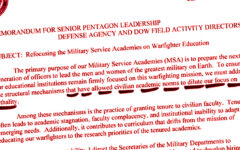
As Supreme Court Justice Clarence Thomas highlighted in his concurring opinion in Students for Fair Admissions, Inc. v. President and Fellows of Harvard College, “It is becoming increasingly clear that discrimination on the basis of race—often packaged as ‘affirmative action’ or ‘equity’ programs—are based on the benighted notion ‘that it is possible to tell when discrimination helps, rather than hurts, racial minorities.’”3 The administration’s and court’s actions reversed years of overcorrection the DEI bureaucracy imposed on the military and its service academies.
As the executive order states, “No individual or group within our Armed Forces should be preferred or disadvantaged on the basis of sex, race, ethnicity, color, or creed.” Few would find this a lamentable statement, and, along with Hegseth’s memorandum, it restores faith in the notion of color-blindness and equal opportunity—ideals that promote the unity and cohesion critical to the proper functioning of our nation’s armed forces.
Further, the order returns the Naval Academy to its proper role in producing officers of character, integrity, and fairness. The executive order also prohibits “promoting” or “advancing” divisive concepts such as “race or sex stereotyping,” which also does not appear to be controversial.
In response, three Naval Academy graduates asserted in a recent essay, “Warriors Don’t Fear Ideas,” that “suppressing ideas” and “stifling academic inquiry” at the Naval Academy will be the inevitable outcome of these changes.4 As evidence, the authors list nine instances of recent actions taken by the Naval Academy from October 2024 (during President Joe Biden’s tenure) to May 2025 that ostensibly prove a “concerted [institutional] effort to suppress and stifle.”
Reviewing a sample of the list suggests the likely motives for some of the actions during this time, which appear consistent with recent executive orders and longstanding DoD directives. Others the authors noted, such as evaluating affinity groups and clubs, remain under review or were mistakes, as when someone removed a display honoring female Jewish graduates—an error Academy officials recognized and acted quickly to fix.
First, canceling Dr. Ruth Ben-Ghiat’s invitation to speak during 2024’s annual Bancroft Lecture, mere weeks before voting would occur in a contentious presidential election year, was consistent with DoD Directive 1334.10. Notably, subparagraph 4.1.5 states, “Any activity that may be reasonably viewed as directly or indirectly associating the Department of Defense . . . or any component of these Departments with a partisan political activity or is otherwise contrary to the spirit and intention of this Directive shall be avoided.”5
As a vocal critic of then–presidential candidate Trump, Dr. Ben-Ghiat’s invitation to speak was an ill-advised choice for a military organization duty-bound to remain apolitical.6 By inviting her to do so, the Naval Academy arguably gave the appearance of supporting a political viewpoint. This would have been equally inappropriate had the Academy invited a speaker who had a consistent record of publicly criticizing Vice President Kamala Harris and the Biden administration.
Second, most alumni agreed that the removal of 381 books from the Naval Academy’s Nimitz Library was inappropriate. But was this part of a “concerted effort to stifle and suppress” learning and academic freedom, as the authors argue? Removing 381 books out of tens of thousands of titles cannot possibly be an institutional effort to ban books or constrain learning. Most books have since been returned, and a DoD memo dated 9 May 2025 outlines the review process to better align with executive orders and the military’s mission.7
The authors of “Warriors Don’t Fear Ideas” also remind readers that “if the Naval Academy is to develop future warriors, scholars, leaders, and citizens of the highest caliber, it must encourage them to think independently. . . . It must strive to remain independent from partisan politics.” The authors then write that “censoring reading lists, limiting exposure to controversial ideas, and selecting content and guest speakers by political affiliation conflicts with the moral and mental development of naval officers. It belies the purpose of the Naval Academy and the understanding of the nature of duty.” In fact, the “concerted effort to suppress and stifle” was a discriminatory politicized agenda put in place under the guise of DEI.
It is unfortunate the authors missed the opportunity to critically analyze the roots of what ultimately became a DEI apparatus formalized, for example, in the Naval Academy admissions process and the former Office of Diversity, Equity, and Inclusion (ODEI).8 The recent Students for Fair Admissions, Inc. v. USNA case revealed racial preferences play a role in admission outcomes.9 And the ODEI, in alignment with the Diversity Peer Educator (DPE) Program, acted as a mechanism to “ensure DPEs are in line with USNA’s Office of Diversity, Equity, and Inclusion (ODEI) messaging.”10
Military institutions, including the U.S. Naval Academy, began implementing formalized diversity and inclusion programs following President Barack Obama’s 2011 Executive Order 13583, “Establishing a Coordinated Government-wide Initiative to Promote Diversity and Inclusion in the Federal Workforce.”11 This order directed the development and implementation of diversity and inclusion strategic plans.
Over the next decade, these initiatives accelerated and expanded, including during President Trump’s first term, with the development of DEI strategic plans and centralized offices such as DoD’s Office of Diversity, Equity, and Inclusion (ODEI).12 Subordinate commands followed by creating their own offices, and in 2021, President Biden issued Executive Order 14035, “Diversity, Equity, Inclusion, and Accessibility (DEIA) in the Federal Workforce.”13
Beginning in fiscal year 2020, the National Defense Authorization Act (NDAA) mandated the Secretary of Defense design and implement a five-year strategic plan for diversity and inclusion.14 By 2021, diversity, in one form or another, was referenced 113 times in the NDAA, including the creation of a Chief Diversity Officer and a requirement for senior DEI advisors to be assigned to each branch of service. Subsequent NDAAs included similar language that further formalized DEI.
In 2022, Defense Secretary Lloyd Austin created the Defense Advisory Committee on Diversity and Inclusion. From the beginning it seemed uninterested in, even hostile, to opposing viewpoints and inputs.15 As Arizona State University’s Center for American Institutions noted in its 2024 report Civic Education in the Military, DoD created a “vast DEI bureaucracy” with innumerable offices and programs as well as funding increases year-over-year, that over time institutionalized a discriminatory ideology and quashed viewpoint diversity.16
These actions would combine to create a culture of intellectual conformity ill-suited to confronting this nation’s foes and providing for its security. As the authors of “Warriors Don’t Fear Ideas” rightly note, the Naval Academy’s current and future professors, instructors, and mentors must exhibit diversity of thought and viewpoint to “encourage [midshipmen] to think independently.” Further, the institution should be devoid of partisan politics.
I am grateful for the shift to open debate about issues that previously were taboo under DEI, such as the role race should play in admissions, and the implementation of the DPE program at the midshipmen level.17
Curiously, the authors omit this censorship, suppression, and stifling from their analysis. Veteran groups, alumni organizations, and other concerned individuals sounded the alarm at the start of this decade, but the warnings largely fell on deaf ears.18
Is it possible the pendulum could swing too far in the other direction? The authors no doubt believe this has begun under the current administration. But the evidence to date, including executive orders and DoD memos directing a reversal to bring the military and service academies back to the status quo ante of equal opportunity and color-blindness, are hardly extremist policies. Rather, they will foster an open environment in which ideas can germinate, flow freely, and be debated without fear of reprisal.
The military and the Naval Academy are not mirrors of society but rather serve it; they are unique and must remain so. It is important to remember they are first and foremost military institutions, and their primary function is to produce commissioned officers. While they may share attributes with their civilian academic counterparts—degree granting academic institutions—they are distinctly different by the nature of their missions and the products they produce.
As the renowned political scientist Samuel P. Huntington wrote, “The dilemma of military institutions in a liberal society can only be resolved satisfactorily by a military establishment that is different from but not distant from the society it serves.”19 Or as the historian Marc Bloch wrote, “Within the body of the nation the officers of the regular army form a separate and distinct society.”20 Any program that betrays this concept and attempts to remake the military contrary to its Constitutional purpose must be confronted because “it belies the purpose of the Naval Academy and the understanding of the nature of duty.”21
The authors of “Warriors Don’t Fear Ideas” also mention some notable Naval Academy graduates, including Vice Admiral James Stockdale, to highlight the importance of a liberal education free from the constraints of political indoctrination. They write, “When our nation calls on Naval Academy graduates to act with honor, intelligence, conviction, and bravery, the United States can rely on their critical thinking, creativity, and ability to lead in times of trouble.”
Commenting on the cultural and societal upheavals of the 1960s, Stockdale wrote of the distressing drift from traditional, classical education. He wrote that “while we pursue the keys to the kingdom of modernity—studies in political science, and economics, and high technology—we need to understand the importance of a broad background in the readings of antiquity, those readings that form the basis of our civilization.”22 The Naval Academy’s recent experimentation with DEI tested and upset this balance.
Modern day warriors do not fear ideas. Unfortunately, in recent years DEI programs have demanded a one-dimensional viewpoint centered on identity in which few debates were allowed or tolerated. Recent executive orders and DoD memos will hopefully return open discussion in which diverse ideas and their merits and flaws can be debated without fear of shame, reprisal, or cancellation. This is, after all, how one seeks truth.
1. The White House, “Restoring America’s Fighting Force,” 27 January 2025.
2. Office of the Secretary of Defense, “Certification of Merit-Based Military Service Academy Admissions,” memorandum, 9 May 2025.
3. Supreme Court of the United States, Students for Fair Admissions, Inc. v. President and Fellows of Harvard College, 600 U.S. (2023).
4. Jason Chen, Kristen Kavanaugh, and Michael Smith, “Warriors Don’t Fear Ideas,” U.S. Naval Institute Proceedings 151, no. 6 (June 2025).
5. Department of Defense, DoD Directive 1344.10, “Political Activities by Members of the Armed Forces,” 19 February 2008.
6. Ruth Ben-Ghiat, “Donald Trump and Authoritarianism,” ruthbenghiat.com.
7. Office of the Under Secretary of Defense for Personnel and Readiness, “Reviewing the Department’s Military Educational Institution Library Collections,” memorandum, 9 May 2025.
8. U.S. Naval Academy, “Office of Diversity, Equity, and Inclusion,” last modified 8 December 2023, archived at Internet Archive.
9. Matthew H. Ormsbee, “Anchors Astray: Why the Service Academy Exception Is Wrong,” Harvard Law Review Blog, 5 January 2025.
10. U.S. Naval Academy, Commandant of Midshipmen Instruction 1500.5: “Diversity Peer Educator Program.”
11. President Barack Obama, “Executive Order 13583: Establishing a Coordinated Government-Wide Initiative to Promote Diversity and Inclusion in the Federal Workforce,” 18 August 2011.
12. “Diversity, Equity, and Inclusion in the U.S. Department of Defense,” GovFacts.org.
13. Taylor N. Riccard, Executive Order 14035 Implementation: Diversity, Equity, Inclusion, and Accessibility (DEIA) in the Federal Workforce (Washington, DC: Congressional Research Service, 3 June 2024).
14. U.S. Congress, Public Law 116–92, National Defense Authorization Act for Fiscal Year 2020.
15. “URGENT: DoD Canceled Our Attendance at Their DEI Public Meeting,” STARRS, 1 May 2024; and Scott Sturman, “DACODAI Avoids Public Criticism,” Brownstone Institute, 9 May 2024.
16. Center for American Institutions, “Civic Education in the Military,” Arizona State University, 2024.
17. U.S. Naval Academy, Commandant of Midshipmen Instruction 1500.5.
18. See STARRS, Calvert Task Group, and CDR Salamander’s “Diversity Thursday” blog posts; and Bing West, “The Military’s Perilous Experiment” Hoover Institution, 23 June 2021.
19. Civil-Military Relations Project, Civil-Military Relations, American Enterprise Institute, July 2017.
20. Marc Bloch, Strange Defeat (New York: Oxford University Press, 1999) 33.
21. Chen, Kavanaugh, and Smith, “Warriors Don’t Fear Ideas.”
22. James Stockdale, Thoughts of a Philosophical Fighter Pilot (Stanford, CA: Hoover Institution Press, 1995) 57.
Commander Cauthen graduated from the U.S. Naval Academy in 2002 and taught in the History Department from 2007 to 2010.
First published in Naval Institute Proceedings
Related Posts







CONTACT US